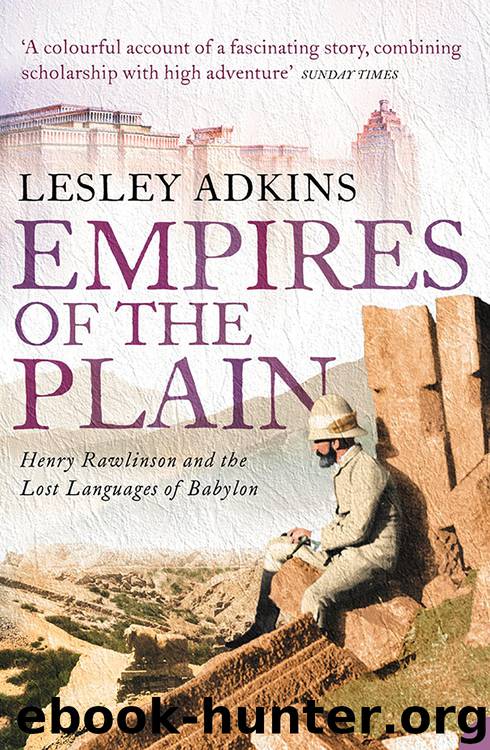
Empires of the Plain by Lesley Adkins
Author:Lesley Adkins [Lesley Adkins]
Language: eng
Format: epub
Published: 2017-02-18T05:00:00+00:00
Fourteen: Battling with Babylonian
At Baghdad the raft with Layard’s Black Obelisk arrived, and on 6 January 1847 Rawlinson, suffering from a very bad cold, wrote to say that ‘yesterday morning the cases were hauled up to the high open space in front of our Naval depot – they cannot be taken inside – but they are out of reach of a rise of the water, and I will have a tent pitched over them from the rain. I took a squint at the black obelisk last night and liked its appearance vastly.’¹ Once the case was opened, he was amazed by it, admitting that ‘I have during the last fortnight thrown aside all other Cuneiforms and set to work tooth and nail at the Assyrian … I have copied the obelisk Inscription, but not yet attacked it in form – indeed, I wish to work out the elements satisfactorily before I go into details. The monument itself is, I conceive, the most noble trophy in the world and would alone have been well worth the whole expense of excavating Nimrud. I have now pretty well made up my mind to run up to Mosul during next month or at the latest in March – and we would there arrange all details about publication.’² He felt that this exciting discovery, once fully deciphered, ‘will, I suspect, cast Egyptology entirely into the shade.’³
The decipherment of Akkadian (Assyrian and Babylonian) cuneiform had not reached anywhere near the point where this well-preserved inscription could be read, but in Ireland, whenever his duties as a clergyman allowed, Hincks continued to work hard on decipherment. A few months earlier John Lee, a scientist and collector of antiquities living near Aylesbury, had advised him to contact Reverend George Renouard of the Royal Asiatic Society who had access to Rawlinson’s Bisitun manuscript and could therefore supply Hincks with more recent information. In mid-December 1846, Renouard received the letter Rawlinson had sent him six weeks earlier and immediately divulged some of it to Hincks, including Rawlinson’s fear of being beaten by Hincks in Babylonian cuneiform. He also quoted from Rawlinson’s letter: ‘I am indebted to him [Hincks] indeed for a most notable discovery, one in fact which has proved of more use to me even than my Behistun key.’⁴
What proved significant to Rawlinson was that Hincks had mentioned in a letter to the Literary Gazette back in July that a fragmentary clay cylinder, published over twenty years previously by the traveller Ker Porter, had a cursive version of the East India House Babylonian inscription, both of which had been discovered at Babylon. The scripts appeared different, because one was inscribed with reeds on damp clay (a ‘cursive cuneiform’) and the other was engraved in stone (a ‘lapidary cuneiform’). Rawlinson therefore realized that the clearly defined inscriptions on the stone relief sculptures being excavated by Layard at Nimrud were the same script and language as the more indistinct inscriptions on clay objects.
By now Hincks had received the first part of
Download
This site does not store any files on its server. We only index and link to content provided by other sites. Please contact the content providers to delete copyright contents if any and email us, we'll remove relevant links or contents immediately.
Fanny Burney by Claire Harman(26662)
Empire of the Sikhs by Patwant Singh(23136)
Out of India by Michael Foss(16987)
Leonardo da Vinci by Walter Isaacson(13412)
Small Great Things by Jodi Picoult(7230)
The Six Wives Of Henry VIII (WOMEN IN HISTORY) by Fraser Antonia(5559)
The Wind in My Hair by Masih Alinejad(5140)
A Higher Loyalty: Truth, Lies, and Leadership by James Comey(5018)
The Crown by Robert Lacey(4865)
The Lonely City by Olivia Laing(4843)
Millionaire: The Philanderer, Gambler, and Duelist Who Invented Modern Finance by Janet Gleeson(4539)
The Iron Duke by The Iron Duke(4407)
Papillon (English) by Henri Charrière(4324)
Sticky Fingers by Joe Hagan(4256)
Joan of Arc by Mary Gordon(4157)
Alive: The Story of the Andes Survivors by Piers Paul Read(4078)
Stalin by Stephen Kotkin(4007)
Aleister Crowley: The Biography by Tobias Churton(3672)
Ants Among Elephants by Sujatha Gidla(3495)
